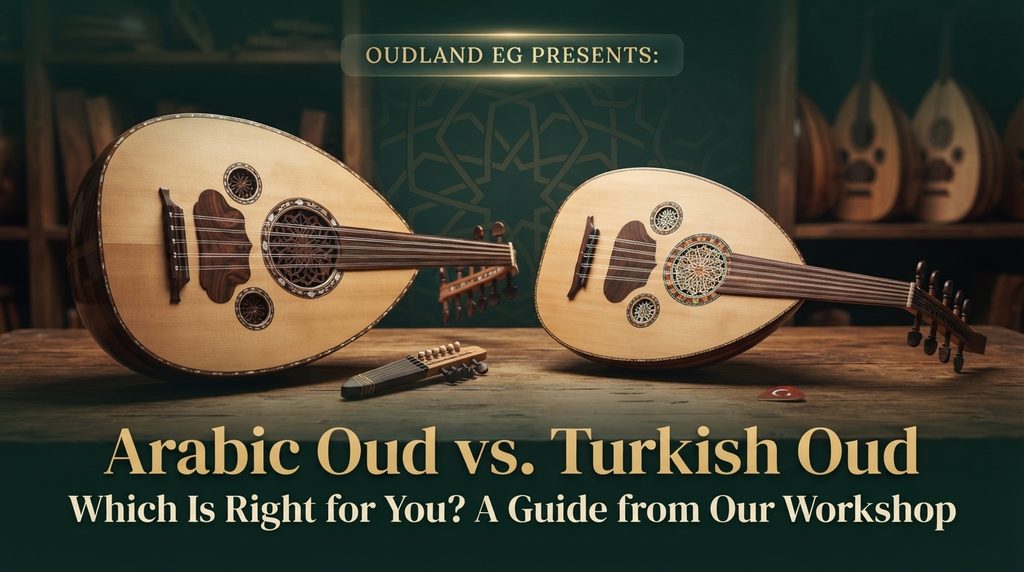
The oud sits at the heart of both Arabic and Turkish music, and at first glance the two main styles look almost identical: a deep, pear-shaped body, a short fretless neck and a bent-back pegbox. Pick one up, though, and the differences soon become clear. They come down to five things: scale length, tuning, bridge, tone and repertoire.
This guide explains each one in plain language, so you can choose the oud that fits the music you want to play.
The Short Answer
- Choose an Arabic oud if you play Egyptian, Levantine, Iraqi or Gulf music, or you want a deeper, warmer voice and the setup most Arabic teachers and recordings use.
- Choose a Turkish oud if you play Turkish classical (makam) or folk music, or you prefer a brighter, more compact instrument.
- Not sure? Start with your repertoire and your teacher. The right oud is the one built and voiced for the music you love.
Scale Length: How Long Is the String?
Scale length is the vibrating length of the string, measured from the nut to the bridge. It is the most useful single measurement on an oud, because it affects tension, tone and comfort.
- Arabic ouds: usually about 60 to 62 cm, with many fixed-bridge models around 61 cm. Some Arabic ouds are shorter.
- Turkish ouds: typically about 58.5 cm.
A longer scale gives the strings more room to vibrate, which generally means more projection, depth and clarity. A shorter scale feels more compact under the hand, with finger positions slightly closer together, and is often easier for smaller hands. Neither is better. They are simply built for different pitches and different tastes.
Tuning: Do–Do or Fa–Fa?
Oud players often describe a tuning by its outer courses, spoken in solfège. The classic Arabic setup is Do–Do (C–c), usually C F A D G C from the lowest course to the highest. Turkish tuning sits roughly a whole step higher, and shorter-scale instruments, including many Turkish-style and floating-bridge ouds, are often set up in higher tunings such as Fa–Fa (F–f).
Why this matters
Strings are made for a particular scale length and pitch. Tuning an oud higher than it was built for raises the tension and can strain the soundboard and bridge, so always ask which tuning an instrument is designed for, and buy strings to match. Tell us your preferred tuning and we will confirm what suits each oud.
The Bridge: Fixed or Floating?
Turkish ouds use a fixed bridge, glued to the soundboard, with the strings tied directly to it. Arabic ouds come in both styles. The classic Egyptian and Syrian oud is usually a fixed-bridge instrument, while the floating bridge, which rests on the soundboard held by string tension with a separate string anchor, became popular in Iraq.
- Fixed bridge: simple and stable, and the traditional choice, often described as warm and earthy.
- Floating bridge: often described as more open and sustaining, and common on shorter-scale instruments.
Timbre: Warmth or Brightness?
Arabic ouds, with their longer scale and typically larger bowl, are generally described as deeper, warmer and rounder, with a strong bass. Turkish ouds are generally brighter and more focused, with a crisp attack and a clear, singing top end.
These are tendencies, not rules. The woods, the bracing and the maker’s voicing matter as much as the label on the instrument.
Repertoire: What Do You Want to Play?
Arabic ouds are the natural home of taqsim improvisation, tarab and the great Egyptian song tradition, as well as Levantine and Iraqi music. Turkish ouds are built for Ottoman classical and Turkish makam music, and are also used in Greek and Armenian traditions.
With the right strings and tuning you can cross between styles, and many professionals own both. Still, each is voiced for its own tradition, so match the instrument to your main repertoire.
How to Decide
- Start with your music. Which maqamat and songs do you want to play first?
- Ask your teacher. Lessons, tabs and recordings usually assume one tuning.
- Check your reach. A shorter scale can feel friendlier if you have smaller hands.
- Think about other players. If you will play with an ensemble, match its tuning and pitch.
- Confirm the details. Ask the maker about scale length, tuning and recommended strings before you buy.
Arabic and Turkish Oud at a Glance
- Scale length: Arabic about 60 to 62 cm; Turkish about 58.5 cm.
- Tuning: Arabic Do–Do (C–c); Turkish roughly a whole step higher.
- Bridge: Arabic fixed or floating; Turkish fixed.
- Tone: Arabic deeper and warmer; Turkish brighter and more focused.
- Repertoire: Arabic taqsim, tarab and Egyptian song; Turkish makam music.