
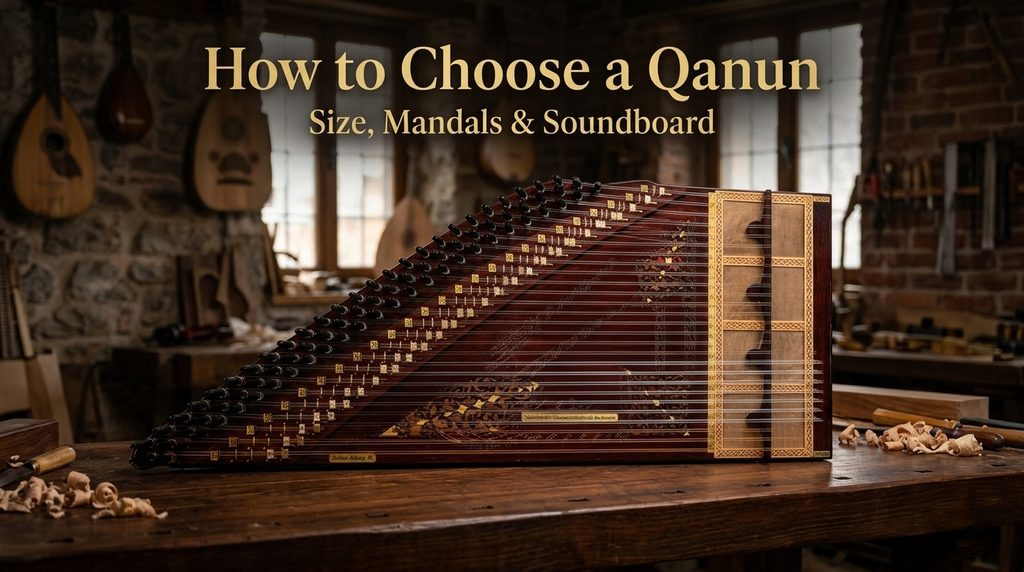
The qanun is the piano of Arabic music: a large trapezoid zither played flat on the lap or a table, with 78 strings and rows of tiny levers that bend pitch by microtones. Choosing one can feel daunting. These are the five things that matter most.
Size: 26 Courses and Standard Dimensions
A standard qanun has 26 courses of strings, with three strings tuned in unison in each course, giving 78 strings in total. Some Arabic models add a few extra strings, which gives more room at the extreme bass and treble. The range covers roughly three and a half octaves.
Turkish kanuns are typically about 95 to 100 cm long and 38 to 40 cm wide, while Arabic qanuns tend to be a little larger. A bigger body usually brings more bass presence and sustain. A slightly smaller one is easier to carry and to rest on your lap.
- Full size, 26 courses: the choice for stage performance and recording.
- Mid-size, 26 courses: the same range in a more compact body, ideal for practice and travel.
Mandals: Arabic and Turkish Systems
Mandals are the small levers beside the tuning pegs. Raising one shortens the sounding length of that course and lifts its pitch by a small step. This is what lets you play microtonal maqamat such as Rast, Bayati and Sikah, and change maqam in the middle of a piece.
Arabic mandals
Arabic qanuns are built around the quarter-tone system, typically with up to four levers per course. That is enough for the intervals of Arabic maqam, and the layout is quick to set and easier to learn.
Turkish mandals
Turkish kanuns divide the tone much more finely, so they carry considerably more levers per course. This suits Turkish makam theory, but it means more levers to manage and a steeper learning curve.
If your repertoire is Arabic, an Arabic-style qanun is the natural choice. If you play Turkish makam music, a Turkish-style instrument gives you the finer intervals it needs.
Soundboard Wood: Cedar or Spruce
The wooden part of the soundboard is usually spruce or cedar, mounted on a body of walnut, mahogany or a similar hardwood.
- Spruce: stiff and light, generally bright, clear and projecting.
- Cedar: softer in response, generally warmer and rounder.
- Seasoning matters: well-aged wood stays stable, keeps its tuning and ages gracefully, whichever species you choose.
Skin or Synthetic Fish-Skin Head?
The right-hand side of a qanun’s soundboard is a window of skin, traditionally fish skin, on which the bridge rests. This membrane gives the instrument its distinctive, plucky voice.
- Natural skin: the classic tone, with a warm, natural attack. It reacts to humidity and temperature, so pitch and sound can drift, and it needs careful handling.
- Synthetic head: made to imitate fish skin. It is far more stable in changing climates and needs less upkeep, which suits touring musicians and buyers in very humid or very dry countries. Some purists hear a slightly different attack.
If you live far from Egypt or travel often, a synthetic head is a practical choice. If you want the traditional voice and can keep your room’s humidity steady, natural skin is the classic option.
Weight and Portability
A full-size qanun typically weighs around 4 to 6 kg and is played on the lap or on a table. Think about where and how you will play.
- Will you sit with it on your lap, or use a table or stand?
- How often will you travel, and do you need a case that meets airline rules?
- Would a mid-size body give you everything you need? Our Saltana Mid-Size Qanun is built in a size that travels with you.
Other Checks Before You Buy
- Mandals move smoothly and silently, and stay where you set them.
- Tuning pegs hold pitch without slipping.
- The bridge sits flush and stable on the skin.
- A case, plectra rings and a tuning key are included, or available.
- You can listen to a recording of the exact instrument first.
Quick Recommendations
- Learning at home: a stable setup with a synthetic head, with levers matched to your repertoire.
- Touring performer: a mid-size body, a synthetic head and a sturdy case.
- Traditionalist: a full-size instrument with natural skin, kept in a stable room.